
How to Choose a Part-Time Baking Course in Johor Bahru (2026)
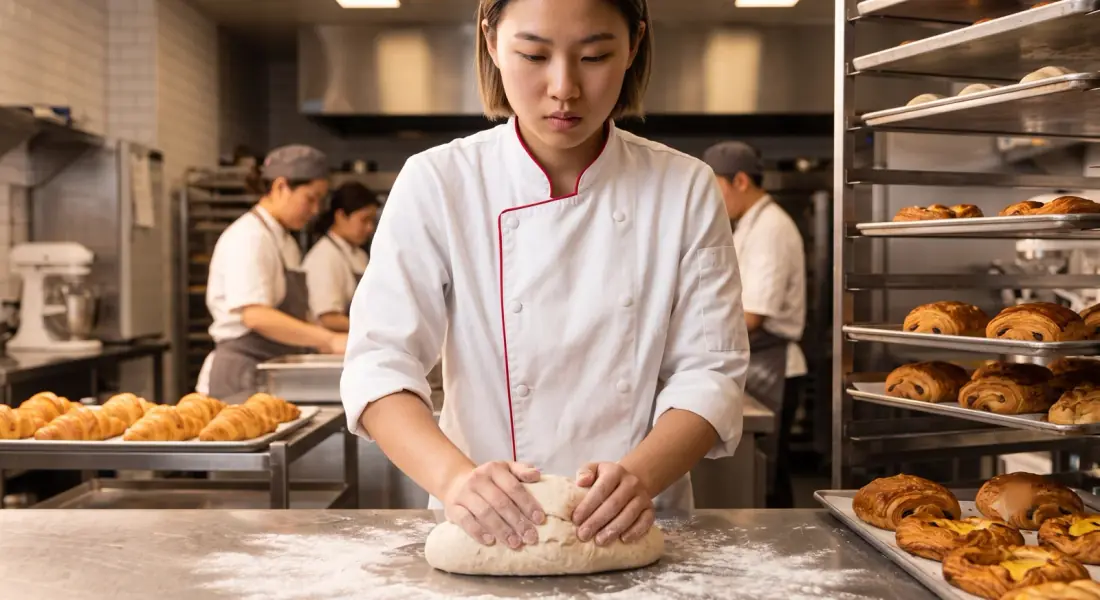
A part-time baking course in Johor Bahru (JB) can train you to a professional standard without giving up your job, if it runs in full weekend days, puts the dough in your hands and teaches the theory behind each step. Take it one stage at a time and you can stop if it isn't for you.
Randstad's 2026 Workmonitor found that 36% of Malaysians in traditional full-time roles would prefer to keep their job and run a side hustle alongside it (Randstad Malaysia, 2026). Baking suits that plan, because much of the practice can happen at home between classes. For a wider look at the options, see our overview of pastry courses in Johor Bahru.
This guide is published by Pastry Art Academy, which runs a weekend Professional Baking and Pastry Course in Ulu Tiram. The general advice comes first, and we describe our course in a separate section further down.
Key Takeaways
- •Full weekend days suit working adults better than short one-off classes.
- •Judge a course by what you can do at the end, such as checking bread by internal temperature or rescuing a split buttercream.
- •Paying stage by stage lets you test the commitment first.
- •Pastry Art Academy's weekend course in Ulu Tiram, Johor Bahru, runs 9am to 6pm in four stages, each decided and paid separately. Stage 1 needs no experience.
Can working adults learn professional baking on weekends in Johor Bahru?
Workers in Malaysia's services sector averaged 44.0 hours a week in the second quarter of 2026, according to the Department of Statistics Malaysia (DOSM). After a week like that, weekday evening classes are hard to keep up. Working adults can learn professional baking, and full weekend days on a course built for them are the realistic slot.
Since 1 January 2023, Malaysia's Employment Act has capped normal working hours at 45 a week, down from 48, as law firm Skrine noted in its December 2022 alert. Employees can also apply in writing for flexible working arrangements, which is worth knowing if your roster includes weekend shifts.
Bread is the clearest case for full days. A loaf runs on its own clock: you mix and knead, leave the dough for a first (bulk) proof, shape it, give it a second proof, bake it, then let it cool before slicing, because cutting a hot loaf leaves the crumb gummy. The two proofs alone can take a couple of hours, faster or slower depending on how warm the kitchen is. In a two-hour evening slot you might see only the mixing, or only the bake. A 9am to 6pm day is long enough to follow one batch from flour to slice, and to see what went right or wrong at each step.
Jobstreet's 2026 Workplace Happiness Index, a survey of about 1,000 Malaysian workers, found that 41% feel burnt out or exhausted by their jobs (New Straits Times, 2026). A baking course won't fix a hard job. Still, a day of making things with your hands is a different kind of tired from a week at a screen.

Three kinds of weekend baking class in Johor Bahru
'Weekend baking class' in Johor Bahru can mean three different things: short do-it-yourself (DIY) sessions for fun, single-day classes on one skill, and structured professional courses taught in stages. Knowing which one you need before you book saves money and disappointment.
DIY sessions are leisure. You decorate a cake or bake cookies in a couple of hours and take them home, which makes a lovely outing but isn't designed to teach you why a sponge collapses.
Single-day classes go deeper on one product or technique. They're also a low-commitment way to see how a school teaches before you sign up for more.
Structured professional courses ask more of you. They build skills in sequence, teach the theory behind each technique and aim for results you can repeat batch after batch. If you want consistent bakes, paid orders or your own bakery one day, this is the format to compare.
What should a good part-time baking course teach you?
A good part-time baking course should teach you why recipes work. Randstad's 2026 Workmonitor found that 63% of Malaysian workers are looking to future-proof their skills on their own, outside employer-led programmes (People Matters, 2026). If you're funding a course yourself, judge it by what you can do at the end.
Recipes are easy to find. Explanations aren't: what the egg is doing in a sponge, why a dough tears, why a cake turns dry two days later. In our view, a good course teaches ingredient knowledge, technique and product stability together, because together they explain most of what happens in your oven.
Four things a first stage should leave you able to do
A good first stage should leave you able to judge bread by its internal temperature, make a buttercream that holds in Johor's weather, name the cause of a failed bake and plan a full production day. At Pastry Art Academy in Johor Bahru, Stage 1, Professional Baking Foundation, starts from zero and teaches all four.
Bread: mix, knead, proof and bake a lean loaf and a soft enriched dough, and judge doneness by internal temperature rather than colour.
Crust colour can fool you in a hot oven. A thermometer won't.
Creams: cook pastry cream, whip a ganache, and make a buttercream that holds in Johor weather and rescue one that has split. Recipes written for cooler, drier kitchens often struggle in our heat and humidity.
Diagnosis: look at a failed bake and name the cause, whether the dough was under-proofed or over-mixed, the oven too hot or the fat too warm.
Once you can read a failure, you stop repeating it.
Planning: organise a nine-hour production day so bread, cake and tart come out on time, then store each one so it keeps. Anyone hoping to sell, even a few orders a month, needs this early.
Seven checks before you enrol on a part-time baking course
Before you enrol on a part-time baking course, check seven things: hands-on time, session and course length, theory, instructors, the kitchen, certificate wording and payment terms.
A seven-point check before you pay
- Hands-on time: how much of each session do you spend working the dough yourself, and how much watching a demonstration?
- Session and course length: is each class long enough to take a bread or cake from start to finish, and how many full days does each stage take in total?
- Theory: are ingredients and the reasons behind each technique taught alongside the practice?
- Instructors: who teaches, and what have they produced professionally?
- Kitchen: visit if you can, and look for professional ovens, mixers and proper bench space.
- Certificates: ask what you receive at the end and who issues it. Some good courses issue no formal qualification at all, and that's fine if the school says so clearly.
- Payment: do you pay for everything up front or one stage at a time, and what happens if you stop partway?
Using a trial class to test the teaching
A single day class is the lowest-commitment way to see a school from the inside, so treat it as an interview as much as a lesson. Watch how much of the day you spend with your own hands in the dough, and how much watching. Notice whether the instructor explains the reason behind each step, such as why the butter has to stay cold or why the dough rests. Then ask an awkward question, like why a cream split or why a loaf came out dense, and judge the answer. A clear, patient explanation is a good sign for a longer course. A vague answer is a warning sign.
Ask, too, which languages the class is taught in. Questions come more easily in the language you think in.
Weekend course, full-time diploma or one-day class: which suits you?
Choosing between a weekend course, a full-time diploma and a one-day class comes down to whether you can step away from work. Malaysia's median monthly salary for paid employees was RM2,940 (Malaysian ringgit) in 2025 (DOSM, 2026), and giving that up for months is a big decision.
A weekend course keeps your income. A full-time diploma is more intensive and leads to a formal qualification. A one-day class tests your interest.

| Factor | Weekend course | Full-time diploma | One-day class |
|---|---|---|---|
| Schedule | Full days on weekends | Weekdays, over several months | A single day |
| Keep your job? | Yes, it is built around working hours | Hard, as classes run on weekdays | Yes |
| How you commit | Depends on the school: up front, or stage by stage | Depends on the school: up front or in instalments | One session |
| What it leads to | Practical skills; check whether any qualification is offered | A formal qualification | Practice with one product or technique |
| Best for | Home bakers who sell a little, people testing a career change, parents and carers | People ready to change careers now | Hobbyists, and anyone trying a school's teaching first |
| Main trade-off | Fewer training days a week than full-time, so you need to practise at home between classes | Means stepping away from work for months | Too short to build consistent, sellable results |
| What to ask the school | How long is each class, how many days does each stage take, and can I pay stage by stage? | Who endorses the qualification, and who issues the certificate? Are instalments available? | Will I work hands-on, and can I ask questions in my language? |
| Example at Pastry Art Academy | Professional Baking and Pastry Course: weekends, 9am to 6pm, four stages, paid one at a time | UK Baking & Pastry Diploma, endorsed by TQUK (Training Qualifications UK): Level 2, 4 months, Monday to Thursday, 9am to 6pm; Level 3, 6 months, Monday to Friday; 0% interest monthly instalments | Day Baking Classes: walk in Monday to Sunday, 9am to 6pm, or book online |
Example schedules from Pastry Art Academy's programme pages. Weekend course tuition is published on the course page.
Choose a weekend course if you want to keep your income and build professional habits. Choose a full-time diploma if you're ready to change careers now and want a formal qualification. Our career change guide walks through that decision. If you can't decide, a day class costs you one day and shows you how a school teaches.
Inside Pastry Art Academy's four-stage weekend course
Pastry Art Academy's Professional Baking and Pastry Course is a part-time course for working adults, with classes on weekends from 9am to 6pm. It is taught hands-on in the academy's professional kitchen at 1A Jalan Cantik 6, Taman Pelangi Indah, 81800 Ulu Tiram, Johor Bahru, about 10 minutes from Mount Austin. Theory is taught alongside practice, in English, Mandarin and Malay. The four stages are Professional Baking Foundation, Professional Order Production, Commercial Baking and Production, and Bakery Business Launch. Stage 1 needs no experience. Students pay one stage at a time and decide on each stage after finishing the one before, and nothing later is booked or charged until they say yes. The course is separate from the academy's diplomas endorsed by Training Qualifications UK (TQUK). Good fits include home bakers who sell a little and people testing a career change or their own bakery.
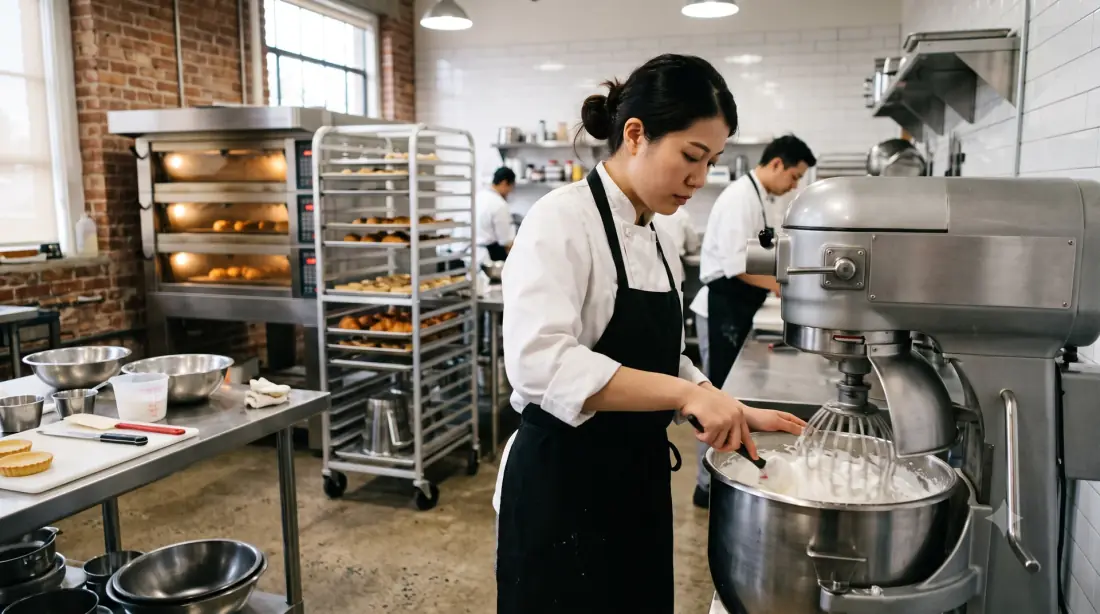
The four stages, in order
- Stage 1, Professional Baking Foundation: bread, cake, cookies, tart and dessert, with ingredient knowledge, technique and product stability, plus basic food costing and selling price.
- Stage 2, Professional Order Production: celebration and premium cakes, made-to-order products, customer requirements, cake assembly and decoration, packaging, storage and transport, order costing and workflow, and a mock customer order.
- Stage 3, Commercial Baking and Production: commercial bread, café products, consistency, portion control, batch production, production planning, shelf life and wastage control.
- Stage 4, Bakery Business Launch: product development, signature products, food costing, pricing, gross profit and margin, menu planning, ingredient purchasing, order management and basic home bakery planning, including a 10-item menu and a bakery launch project.
What taking it in four stages means for you
Each stage has its own focus: a sound foundation, then customer orders, then commercial production, then a bakery launch project with a 10-item menu. Taking one stage at a time lets you check that the training, and your weekends, suit you before going further. If work gets busy after Stage 1, you haven't paid for stages you can't attend.
The academy's instructors
The academy's instructors include Chef Hang, the Lead Instructor, who for years has designed the Sultan of Johor's official birthday cakes. Chef Terry, Head of Bakery, specialises in artisan bread and viennoiserie, has experience at Marina Bay Sands, and won Best Viennoiseries & Artisan Baguette at the FHA Bakery Challenge 2026. You can read more in our profile of the academy's chefs.
What can you do after a part-time baking course?
The realistic next steps after a part-time baking course are baking with more confidence, taking paid orders, or working towards a small bakery or café. Johor had 15,727 food and beverage service establishments in 2022, 11.5% of the national total and second among the states (DOSM, 2024), though the national count has fallen since 2015.
A course can't guarantee a business, but it can give you the skills to try. In our view, consistency and sensible pricing count for more than novelty in a market that size, which is why costing belongs in a good course from the first stage.
For the selling side, see our guide to starting a bakery business in Malaysia. If you're thinking about employment instead, read our piece on demand for bakers in Malaysia.
Choosing a part-time baking course in Johor Bahru: the bottom line
Pick the format that fits your week, then judge the course by what its first stage leaves you able to do.
If you're undecided, start with a day class and see how the school teaches. If you like it, a first stage such as Pastry Art Academy's Professional Baking Foundation teaches you to judge bread by internal temperature, rescue a split buttercream and plan a full production day. Then decide whether to go further. Questions are welcome on WhatsApp.
See the four stages and published tuition
Read the stage-by-stage outline of the weekend Professional Baking and Pastry Course in Ulu Tiram, Johor Bahru, with the schedule and published tuition.
View the Weekend CourseFrequently Asked Questions
Do I need baking experience for a part-time baking course in Johor Bahru?
Not for a good foundation course. Pastry Art Academy's Stage 1, Professional Baking Foundation, starts from zero and goes as far as basic food costing and planning a full production day. If you're nervous, a single Day Baking Class is a low-pressure way to get used to a professional kitchen first. You can walk in Monday to Sunday, 9am to 6pm, or book online.
Can I learn professional baking online instead?
Videos help with revision, but professional baking depends on feel: how a dough should stretch, what a proofed loaf looks like, when a cream is about to split. An instructor beside you spots those things straight away, which is why hands-on classes in a real kitchen are hard to replace.
Can I pay for a part-time baking course in stages?
It depends on the school, so ask for a written breakdown before you enrol. At Pastry Art Academy, you pay for the weekend course one stage at a time: you start with Stage 1, then decide on each stage after finishing the one before. Nothing later is booked or charged until you say yes. Weekend course tuition is published on the course page.
Is a weekend course practical if I work in Singapore?
Often, yes. Malaysia's national news agency Bernama reported in 2025 that between 300,000 and 400,000 people commute across the Causeway every day, which leaves little room for weekday study. Pastry Art Academy's weekend course runs 9am to 6pm on weekends in Ulu Tiram, about 10 minutes from Mount Austin. Our guide for Singaporeans covers the crossing.
Does the weekend course lead to a diploma?
No. It's a Pastry Art Academy course, separate from the academy's TQUK-endorsed diplomas. If a formal qualification is your main goal, the full-time Level 2 diploma (4 months, Monday to Thursday) or Level 3 diploma (6 months, Monday to Friday) is the route designed for it, with 0% interest monthly instalments.
Sources
Department of Statistics Malaysia, Labour Productivity, Second Quarter 2026, retrieved 2026-10-07
Department of Statistics Malaysia, Salaries & Wages Survey Report, Malaysia, 2025, retrieved 2026-10-07
Department of Statistics Malaysia, Economic Census 2023: Food and Beverage Services Sector, retrieved 2026-10-07
Skrine, Employment (Amendment) Act 2022 comes into force on 1 January 2023, retrieved 2026-10-07
Randstad Malaysia, Workmonitor 2026: The end of the linear career path, retrieved 2026-10-07
People Matters, 52% of Malaysian workers take or consider second jobs, increase work hours: Report, retrieved 2026-10-07
New Straits Times, Most Malaysians happy at work, but stress remains concern, retrieved 2026-10-07
Bernama, SOCSO: Malaysians Working In Singapore, Self-employed In M'sia Eligible For Social Protection Scheme (30 October 2025), retrieved 2026-10-07
Cite this article
Pastry Art Academy. (2026). How to Choose a Part-Time Baking Course in Johor Bahru (2026). https://www.pastryart-academy.com/blog/part-time-baking-course-johor-bahru